What DIY can you do at home with an access tower?
Are you planning to renovate your home? Have you got a list of jobs that need doing and the supplies and equipment you’re going to need? Do some of the jobs involve working in areas that are out of reach without some sort of access equipment? If this sounds like you and you’re wondering about the best and safest way to reach high areas of your home, have you considered using an access tower?
A range of scaffold towers for DIY enthusiasts
At Access Towers, we supply a comprehensive selection of different scaffold towers. Our towers are suitable for both commercial and domestic projects and can be specified in a range of different sizes and configurations.
For homeowners wanting a safe, easy-to-use, and cost-effective method of accessing out-of-reach areas of the home, our scaffold towers are the perfect solution. From narrow-width to double-width towers to advanced guardrail towers and stair towers, all our products are tested and certified for their safety and outstanding quality. We even supply cantilever towers for access situations with an obstacle at ground level.
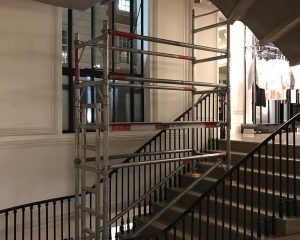
Access towers for any home DIY project
At Access Towers, our range of high-quality scaffold towers and associated products have been used for a diverse range of DIY renovation projects. To give you a true idea of their scope and effectiveness, here are some situations where scaffold towers are an excellent choice.
- Painting your home exterior
- Repairing or replacing roofline products such as guttering, fascias, and soffits
- Cutting down and trimming trees, hedges, and bushes
- Repairing and replacing roof tiles and slates
- Decorating high internal areas such as staircase walls and ceilings
- Installing aerials and antennae
- Replacing and repairing windows above ground floor level
- Cleaning windows and window frames
- Clearing out gutters
- Installing solar panels
As you can see, if there’s an area of your home that you need to reach, scaffold towers are a brilliant solution.
If you’d like to find out more about hiring any of our towers, get in touch today. For more information about any of our products or services call 0208 665 1181 or send us a message online.
What are the benefits of IPAF training?
IPAF (International Powered Access Federation) is a globally recognised provider of operator training for those involved with working at heights. IPAF training covers both practical training and theory-based instruction, conducted at registered training centres across the UK. For those in the construction industry using access equipment like mobile vertical or mobile boom platforms, the IPAF training programme ensures awareness of all safety requirements when working at height.
Why Attend an IPAF Training Course?
In the UK, there are no strict legal requirements to obtain IPAF certification for working at height. However, many employers prefer workers to be conversant with working-at-height regulations and to have undergone appropriate safety training. The Work at Height Regulations 2005 mandate that employers ensure all employees who work at height are competently trained or supervised by a skilled person. IPAF courses offer a comprehensive range of classroom and practical instruction to meet these standards.
IPAF training courses are an effective way to consistently meet on-site health and safety regulations. Individuals aged 16 years or older are eligible to attend IPAF training courses, including the E-Learning for MEWP operators in all MEWP categories (1a, 1b, 3a, 3b). Upon successful completion, attendees receive an IPAF PAL (Powered Access Licence) card, which is valid for five years and acts as proof of their ability to operate various types of MEWPs safely.
Advantages of IPAF Training
Completing an IPAF training course provides several key advantages. Holding an IPAF PAL card can make workers more employable, especially as many roles in the construction industry require certified platform operators who have been trained to the highest standard. Most importantly, IPAF training courses teach safe work practices, including proof of platform operator training, which is critical given the potential risks of working at height. The training covers everything from risk assessment to the correct and safe usage of platforms, ensuring that workers are well-prepared to handle various types of MEWPs including static vertical and mobile boom platforms.

Some other benefits of completing an IPAF training course include:
- Correct and safe usage of platforms
- Safe usage of harnesses and protective equipment
- Understanding the effective use of MEWPs and working at height machinery
- Comprehensive risk assessment processes
- Emergency procedures and hazard recognition
- Safe assembly, usage, and dismantling of access platforms
IPAF training is crucial for ensuring safety and compliance when working at height, making it indispensable for those operating in high-risk environments.
At Access Towers, we are an official IPAF associate, which allows us to allocate delegates to IPAF training courses across London and South East England. To learn more about accessing IPAF training or any other Access Towers services, get in touch today by calling us on 0208 665 1181 or contacting us online.
What Do You Need to Know About IPAF Training?
Discover key details about IPAF training, including course duration, costs, and licence benefits. Whether you’re new to powered access equipment or looking to refresh your skills, this guide will answer your pressing questions and help you understand the importance of IPAF certification for safe and compliant work at height.
Contact Us Today for a Tailored IPAF Training Quote
What is IPAF training?
IPAF training focuses on the safe and efficient operation of Mobile Elevating Work Platforms (MEWPs), including boom lifts and scissor lifts. It combines practical training and theoretical elements to ensure operators are competent in handling these machines safely.
How much does IPAF training cost?
The cost of IPAF training varies depending on the course type and location. For an accurate quote, please contact us directly, and we’ll provide a tailored price based on your needs.
How long does an IPAF course take?
The duration of an IPAF course typically ranges from one to two days, depending on the specific course and the participant’s prior experience with MEWPs.
What does IPAF licence mean?
An IPAF licence, also known as a Powered Access Licence (PAL), is awarded upon successful completion of an IPAF course. It certifies that the holder is qualified to operate specific types of MEWPs safely.
Can I go in a MEWP without IPAF?
While it is not a legal requirement to hold an IPAF licence to operate a MEWP in the UK, it is highly recommended. The Work at Height Regulations 2005 mandate that employers ensure employees are competently trained, and IPAF certification is widely recognised as evidence of such competency.
Our definitive guide to access tower safety
Access towers are extremely useful equipment for working at height. They can be used in a wide variety of scenarios including on construction sites and when working on residential or commercial buildings. Whether it’s maintenance work, exterior painting and refurbishment or the erection of new buildings or installations, access towers are an essential part of many building projects.
To help you understand more about access towers and their uses, we’ve compiled this comprehensive guide. When you want advice on hiring and safely using an access tower, at Access Towers, we have years of expertise to ensure you are fully informed.
Preparing a site for an access tower
Before using an access tower, an in-depth risk assessment of the site and the tower should be conducted. This must be done by a person who has received the appropriate training such as PASMA. The individual should conduct a risk assessment of the site looking for any potential hazards that may pose a danger to the tower users. Low-hanging trees, out-buildings, and uneven ground should all be assessed and the best place for erecting the tower chosen accordingly.
Once the risk assessment has been completed and signed off, the tower is ready to be assembled. A competent person must assemble the tower; preferably someone who has completed a PASMA training course. Once assembled, a pre-use inspection will ensure that the tower is completely safe and ready to use.
During the time that the tower is on site, regular safety checks should be carried out. This will ensure that safety is never compromised, and the tower will remain stable and in excellent usable condition. Any people who use the tower directly or those who work in nearby areas must be fully compliant with all safety regulations. Once the tower is no longer needed, it should be dismantled by a trained individual.
Access towers erection and disassembly
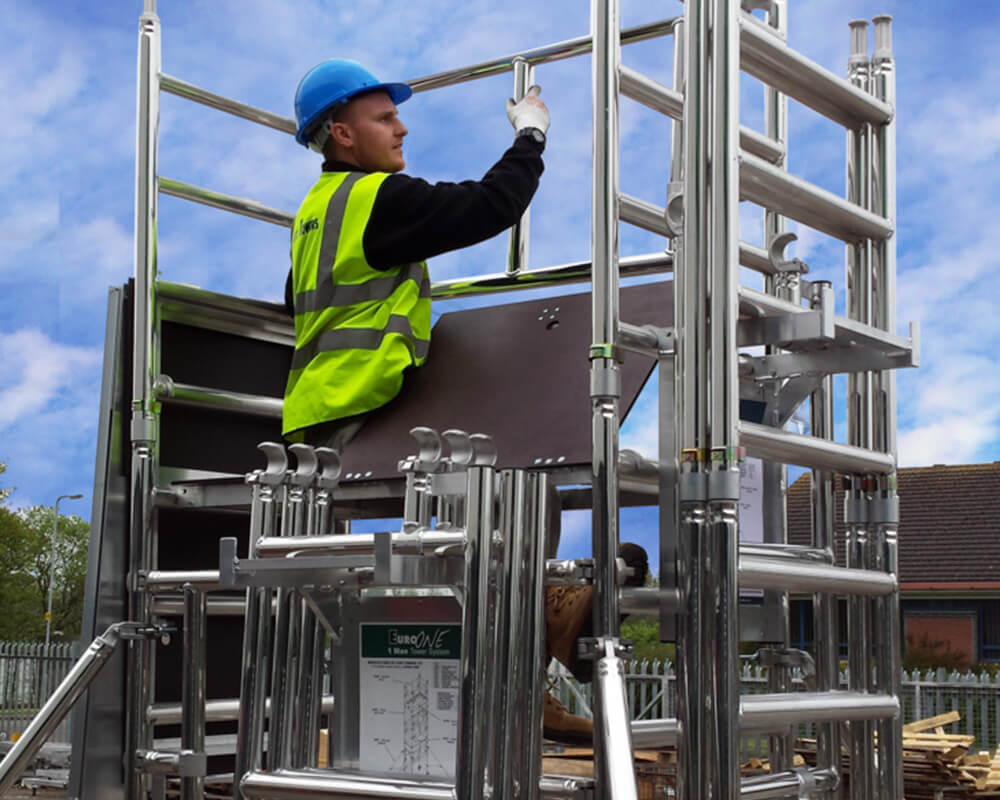
At Access Towers, we provide comprehensive guidance and advice on how to erect, use, and dismantle an access tower. We offer PASMA training courses from our Croydon headquarters to ensure that all our customers are competent when working from height.
Access towers should always be erected using a safe and methodical approach. The two main methods of access tower assembly are:
- Advance guard rail system – Temporary guard rail units are locked in place from a lower level. They are then moved up to the working platform level. The temporary guard rails must be secured in place before the operator can access the platform to install the permanent rails.
- Through-the-trap (3T) system – Guard rail components are added and removed from a working position in the trap door. This method ensures that an operator does not stand on an unguarded platform.
When it’s time to dismantle the tower, this should preferably be done by the same person who erected the unit. The process above should be completed in reverse with the installer working from top to bottom.
Using and moving an access tower
When using an access tower, safety should always be the primary consideration for all users. Important things to consider include:
- Never use an access tower in strong winds
- Never misuse a tower ie. By leaning other equipment against the tower
- Always ensure the tower is correctly assembled
- Carry out regular safety inspections
- Ensure the surrounding area is free from hazards
- Ensure all operators and people on site are compliant with health and safety regulations
Due care and attention should always be taken whenever there is a need to move the tower. Some access towers are fitted with wheels for ease of movement. If you do need to move a tower, the following rules will help to maintain on site safety.
- Reduce the tower’s height to a maximum of four metres
- Ensure that there are no overhead obstructions (trees, power lines etc.)
- Ensure the ground is flat, firm, and free from obstructions and potholes
- Use the base to push or pull the tower to avoid the tower tilting and falling
Essential safety for access towers use
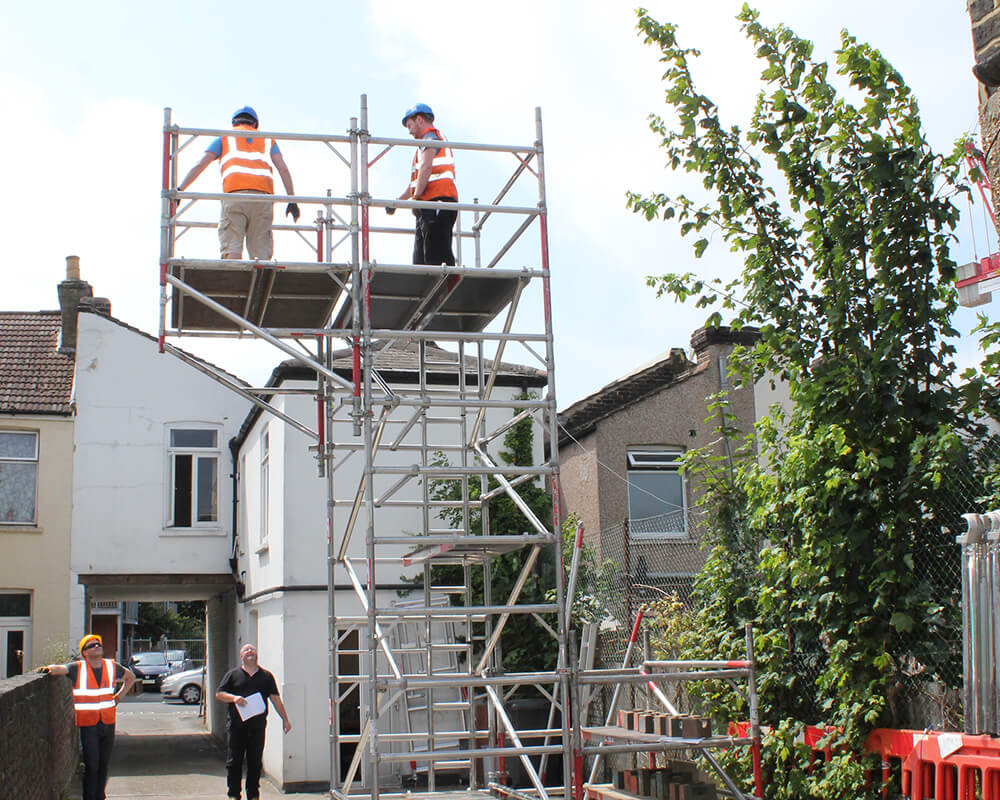
Attending a PASMA course is the best way to learn about the safe use of access towers. These courses are designed to improve user safety and highlight the dangers involved when working from height. Awareness of current Working at Height Regulations will also help to ensure safety standards are upheld when using an access tower.
Alongside the appropriate training and knowledge of safe working practices, it’s a good idea to have some general understanding of safety when using an access tower. Some useful safety considerations to bear in mind include:
- Choose the most appropriate tower for the work you are planning
- If a regular tower check finds a problem, stop all work immediately until the problem is fixed
- Follow the assembly and usage instructions
- Avoid using the tower in harsh weather conditions
- Avoid using a tower on uneven ground
- Avoid overhead obstructions
- Ensure all operators are fully compliant with correct usage procedures
By following these guidelines, you will significantly reduce the chance of on-site accidents and safeguard all workers against danger.
If you’d like to find out more about our range of access equipment, get in touch today. You can call us on 0208 665 1181 or send us a message online.
When is it best to use an access tower?
Access towers are a great way to reach areas above ground level. They are safe, easily movable, and are available in a range of different models and configurations. If you’re planning to carry out any work above ground level, using an access tower is an excellent solution. To give you an idea of when access towers are the best choice, here are the top scenarios when it’s best to use an access tower.
Access towers for stability
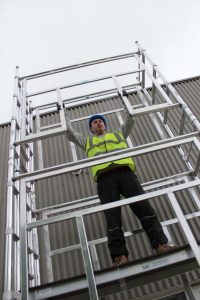
When stability is important for the work you’re doing, access towers are the best choice. Unlike ladders, access towers provide a completely stable platform to work from. Most access towers are designed to stand securely with no additional support and no need for a worker to wait at ground level. The platform is reached by an integral ladder and the unit does not even need to lean against a wall or building for support.
To further increase stability, access towers can be fitted with additional supportive legs. These are installed around the base of the tower and significantly reduce the likelihood of the tower tipping over or becoming unsecure when in use. For exterior painting jobs, roofline repair, or any building maintenance, they are the most stable access solution.
Access towers for mobility
If you’re a builder, installer, or regularly work at height doing any type of maintenance or renovation work, you’ll want an access solution that is easy to move. Access towers have wheels at the bottom of each leg. This allows them to be easily rolled around a site to be used in different areas without disassembling. This is perfect for use on large construction sites or on commercial building renovations. Once the tower is in place, the wheels can then be locked in place for safety when the tower is in use.
Access towers for safety
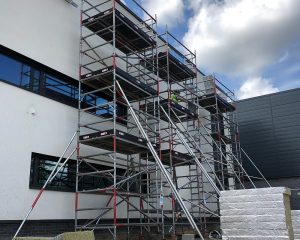
When working from height, worker safety is the most important factor to consider. Where ladders or genie lifts are perfect for certain working at height scenarios, access towers are by far the safest option. This is particularly true if you are working in a live environment such as a school, office, or occupied commercial or residential building.
Access towers are designed to be as safe as possible. They provide a safe working environment for anyone using the tower and they are also safe and will not cause any danger to other people nearby. Their strength and stability ensures that they will not move when in use and although lightweight, they create a sturdy platform for all types of working at height situations.
As you can see, access towers are the best solution for working at height. They should be chosen as the preferred means of access for all work above ground level wherever site conditions allow. If you’d like to find out more about our range of access towers, get in touch today. You can call us on 0208 665 1181 or contact us online.
Related content:
How not to use an access tower
What should you check before using a mobile access tower?
How do I paint my house with scaffold towers?
Painting the exterior of your house may seem a daunting prospect. When you’ve got the right equipment however, it should be a job that any able-bodied homeowner can easily undertake. In this blog, we’ll look at the process of painting your house exterior, the equipment you’ll need and the best scaffold towers to gain access and always ensure a safe working environment.
Why use scaffold towers to paint your house
When you’re planning to paint the exterior of your house, you’re going to need to access some out of reach areas. Exterior house painting will usually fall into one of two categories or potentially both. Firstly, there are houses whose exteriors have a rendered finish over brickwork that has been painted. These finishes will usually require re-painting every seven to ten years.
Secondly, there are houses with areas of timber which may have been varnished, treated, or painted to provide both protection and enhance appearance. Painted exterior woodwork will usually require painting every five to seven years. This will vary depending on the position of the property and its exposure to the elements.
Exterior woodwork includes any areas of cladding and also any roofline and supportive timber battens. When painting exterior woodwork, you’ll need to check the condition of the existing paintwork. If it’s beginning to flake or peel, it will require sanding down before applying a new coat of paint.
Whether you’re painting exterior render or woodwork, there are some essential tools you’ll need for the job.
Exterior house painting essentials
- Wire brush
- Sandpaper
- Water
- PPE (goggles, mask, overalls)
- Exterior primer
- Exterior paint
- Brushes, rollers
- Dust sheets
You may also require a screwdriver to take down any exterior fixtures and fittings before you begin. You will also obviously need a way to access any areas above two meters.
Scaffold towers vs scaffolding vs ladders
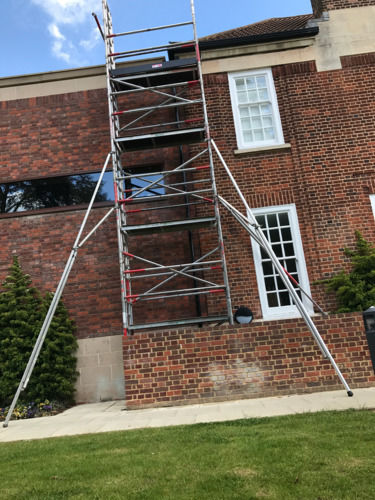
There are three main options for accessing out of reach areas of your house. Ladders are quick and easy to use. They are, however, potentially dangerous, and will always require at least two people on site to ensure safety. Scaffolding is a good option for very large properties, particularly commercial buildings. It is extremely safe to access and use but is probably unnecessary for painting residential properties.
Scaffold towers offer users the best of both worlds. They are small enough to be easy to set up, use and dismantle, like ladders. They also provide a safe platform to work from just like scaffolding but without the hassle and cost of hiring, setting up, and dismantling.
Scaffold towers, like those from Access Towers are available in a variety of sizes and configurations and can be specified to meet your exact requirements.
At Access Towers, we have supplied scaffold towers to homeowners across London and the South East. If you’re planning to paint your home exterior and you want to hire a safe and affordable scaffold tower, contact Access Towers today. You can call us on 0208 665 1181 or send us a message online.
Is access tower hire worth it? Or should I purchase instead?
Purchasing vs Hiring access towers – important factors to consider
Whether you’re a one-man band, a small team or part of a large team of contractors having any form of mobile access tower at your disposal makes light work of any project. Whether it’s painting, gutter clearing, or repairing rooflines, platform towers are a practical alternative to a full scaffold system and having a stable working platform that is freestanding allows you to take all your tools up at once and make work far easier and faster in comparison to a regular ladder.
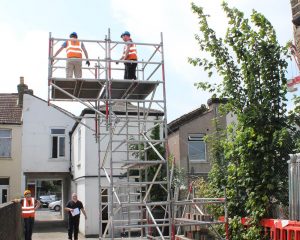
In addition to this, double width access towers provide a wider working area allowing you to complete more of your project, making trips up and down the platform far less frequent. But how do you decide if you need to hire one or purchase one instead? See our table below for a quick and handy reference point to see what suits you or your company.
| Factor |
Hire |
Purchase |
|
Flexibility of product choice?
|
? |
X |
| Does the tower need have any storage requirements when not in use? |
X |
? |
| Do you own the mobile platform? |
X |
? |
| Will you be waiting around for delivery/collection, time that could otherwise be spent on the job at hand? |
? |
X |
| Do you have to maintain the access tower? |
|
? |
|
Will you have access to the latest up to date and efficient models?
|
? |
X |
| Does I require an upfront capital investment? |
X |
? |
| Is there any downtime if the access tower breaks? |
X |
? |
| I only need the access tower for a few weeks of the year – should I hire or purchase? |
? |
X |
Pros and cons of hiring mobile access platform towers
Hiring access towers allows you to choose between an array of mobile platform units ranging from, cantilever tower systems to one man plus towers and even genie lifts. On top of the large selection available to you, you will also have the latest and up to date model that will be easy to assemble and dismantle that requires no maintenance. Where you may need to wait for delivery of the access tower, this can be avoided with some forward planning and is a perfect solution for a one-off job where access from the ground or ladder just isn’t viable.
Pros and cons of purchasing mobile access platform towers?
It can be an expensive venture to front the cash for an access tower but does mean you own the tower and can use it whenever you please. If you’re using it more than half the time it makes sense to purchase a mobile access platform tower, as over time it would outweigh the rental costs. It’s worth noting however that you will be responsible for the upkeep of your tower and when it’s not in use, it will need to be stored somewhere out of the eyes of thieves, which may incur more costs if you need to hire a storage unit.
Mobile access towers for hire across the South East and the UK
At Access Towers we have a wide range of mobile access platforms available for hire to suit any application. Get in touch with us on 0208 665 1181 or fill out a form to provide us with the details regarding your job and a member of our team will look forward to providing you a bespoke quote to suit your project.
What is the difference between PASMA and IPAF?
At Access Towers we provide tower hire for large business and smaller workforces across London and the UK. Ranging from low level units such as Genie lifts and Podium units to high access towers such as Double Width Towers and Advanced Guardrail Towers to suit a multitude of requirements for any project.
What are the requirements for using mobile access towers?
For anyone concerned with the assembly, use, inspection and dismantling of mobile or powered access towers, relevant training is required to adhere to the level of competency set forth by the Working at Height regulations 2005. This training is typically delivered in the form of PASMA training courses for low level, high level, mobile, access towers and IPAF courses for powered access equipment.
Can you provide IPAF and PASMA training courses?
PASMA
As a business we can provide PASMA training at our headquarters in Croydon or on site, whatever suits you and your team. This ranges from courses for managers, users, towers on stairs, cantilevers and towers with bridges which teach you the fundamental knowledge and skills in a 1 day training courses to safely erect, dismantle and operate mobile towers.
Upon completion, you will receive a PASMA certificate and photo card that are valid for 5 years. This card is a widely recognised qualification throughout the industry that demonstrates you can operate PASMA towers, understand PASMA regulations and the BS EN 1004:2020 product standards.
IPAF
IPAF training courses are only held at registered centres across the UK where you will learn the necessary safety skills to assemble, dismantle and use a range of powered access equipment including Scissor lifts, Cherry pickers and Truck mounts. Access Towers are an official associate of IPAF and can assign small or larger teams on to relevant courses throughout London and Surrey.
Upon completion, you will receive a IPAF certificate and a PAL card which is valid for 5 years. Your PAL card is vital because an increasing number of work sites now use access equipment instead of ladders as they provide safely encapsulated areas with less hazards (when operated correctly) and demand appropriate certification to be able to grant access to sites.

The differences between PASMA and IPAF
| IPAF |
PASMA |
|
|
|
- Training completed through IPAF only
|
- Training completed with PASMA or approved centres
|
- For anyone looking to keep them selves safe whilst on site and to act in accordance with the Working at Height 2005 regulations. Typically this can be: Delivery drivers, Supervisors, Installers, Instructors and Technicians.
|
- For managers, users and anyone erecting, dismantling and using mobile access towers. Designed to reduce the number of workplace accidents by satisfying the standards outlined in the Health and Safety at Work Act of 1974.
|
- Certification valid for 5 years
|
- Certification valid for 5 years
|
What should you check prior to using a mobile access tower?
With the recent changes to the current product standard for mobile access towers now firmly in place for tower scaffolding manufacturers across Europe and the UK, it’s important to know how these key changes affect your scaffold and how to check that your mobile access tower is safe and ready to use before you or your team begin a project.
When should mobile towers be inspected?
These are basic guidelines to be followed under The Work at Height Regulations 2005:
- User or accompanying manger must be competent to build, dismantle and carry out a pre inspection on the tower.
- A full risk assessment should be carried out before any work ensues.
- Tower components must be inspected at suitable intervals throughout the project and an appropriate record kept of this inspection.
When should you not use tower scaffolds?
Employees should be sufficiently trained and be physically/mentally fit to undertake the tasks ahead of them. You should never use a mobile access tower if any of the following situations occur:
- As a support for ladders or other equipment
- In strong winds
- With broken, damaged, or missing parts
- With incompatible components that do not adhere to the BS EN 1004:2020 product standard.
What hazards may have been identified in the mobile tower risk assessment?
At Access Towers we supply a range of aluminium scaffold towers for hire and advise to keep a keen eye out for the following hazards prior to use of any mobile access tower that it is possible to fall 2m or more:
- Check for any modification to the scaffold that deviates from the manufacturer’s specification in the manual.
- Defects to the scaffold tower such as: incorrect assembly, missing parts (i.e guardrails) or damage to the structure in anyway.
- Check the ground is suitable for withstanding the weight of the tower. Ensure ground is not uneven, slippery or sloping.
- Overhead obstructions that could cause injury or block access whilst on the mobile access tower.
- Do you have the necessary PPE? Ensure correct footwear is worn, and fall arrest systems are in place if necessary.
- Any electrical hazards.
- Over-reaching. Ensure area to work on is within safe reaching distance of the scaffold tower.
- Ensure necessary warning signage is in place to deter members of the public from gaining access.
- Poor or dim lighting. Visibility is paramount when carrying out work operations.
- Each mobile access tower unit will have its own loading rating specified by the manufacturer that should be adhered to and not exceed.
Approved IPAF and PASMA, mobile access towers and working at height specialists throughout Surrey and the UK
As approved associates of the governing bodies regarding scaffolding towers and mobile access towers, we offer IPAF and PASMA training for users and managers alike to ensure you and your colleagues are safe on site.
From GRP towers, Advanced Guardrail towers to low level Podium units, we are the UK’s leading scaffold supplier and our team of experts can be contacted on 0208 665 1181 for further details or fill out a form for a free quote today.
What is the current product standard for mobile access towers?
Product standard: BS EN 1004
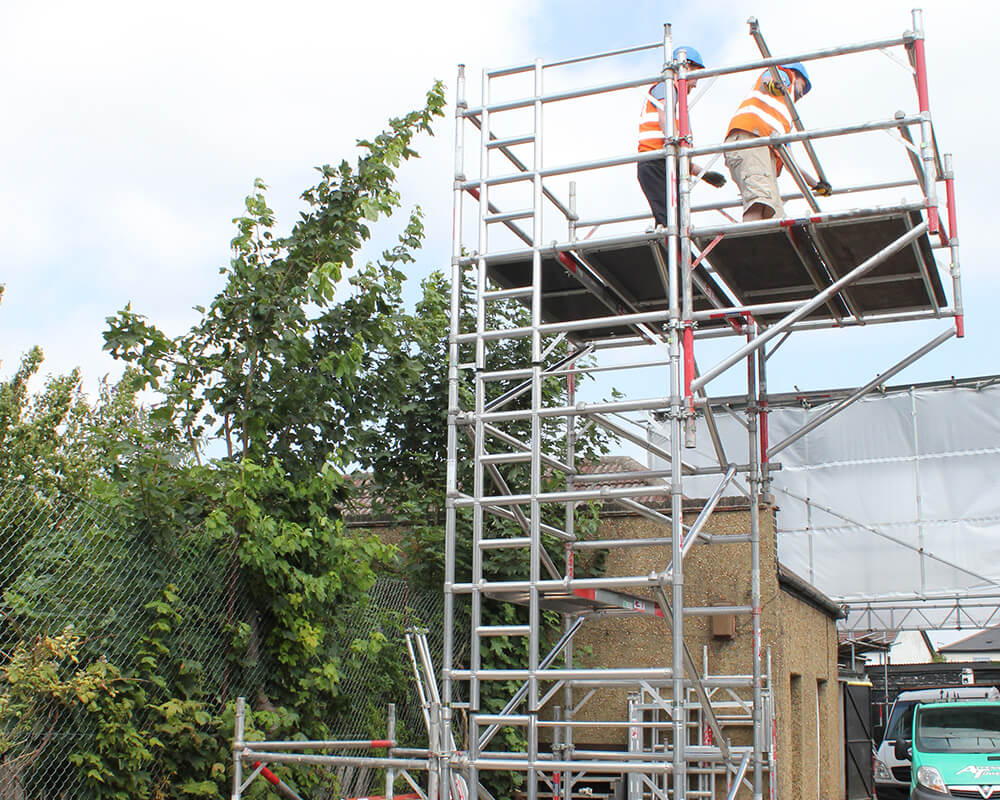
The product standard for mobile access towers is defined under the European standard: BS EN 1004:2004 which covers the manufacturing of mobile access scaffold towers of heights between 2.5m – 8m (external use) and 2.5m-12m (internal use). Any tower with BS EN 1004 certification ensures that the product conforms the minimum safety requirements and is fit for purpose and safe for all users during assembly, use and dismantle.
Its important access towers are regulated as they are pivotal in the work for many traders across London and the UK and need to be safe. For instance, recently a high level specialist decorating company required the use of a cantilever scaffold tower to gain access to an out of reach position on a job at the Wallace Collection Museum, London.
Key changes and transformation of BS EN 1004:2004 to BS EN 1004:2020
Towards the end of 2020, changes were put forth to BS EN 1004:2004 which were to be instated from 30th November 2021, thus changing the standard code from BS EN 1004:2004 to BS EN 1004:2020. In essence, any tower components manufactured past this point must conform to this new product standard to receive the certification. *
These key changes are brought in to make new mobile access towers even safer for all users and to reduce the risk of falling from heights. The changes are as follows:
- Towers of all heights now fall under the scope of BS EN 1004 rather than towers 2.5m or higher.
- Shorter distance between the first platform and the ground. This is now capped at 3.4m, reduced from 4.6m
- Shorter distance between individual platforms. This is now capped at 2.25m, reduced from 4.2m.
- Extra requirement that all platform decks are to be secured at both ends with double wind locks to ensure platforms don’t lift up in windy conditions.
- Extra measures in place to prevent castors from falling out.
Read more on the working at regulations that are designed to prevent death and injury caused by falls from heights.
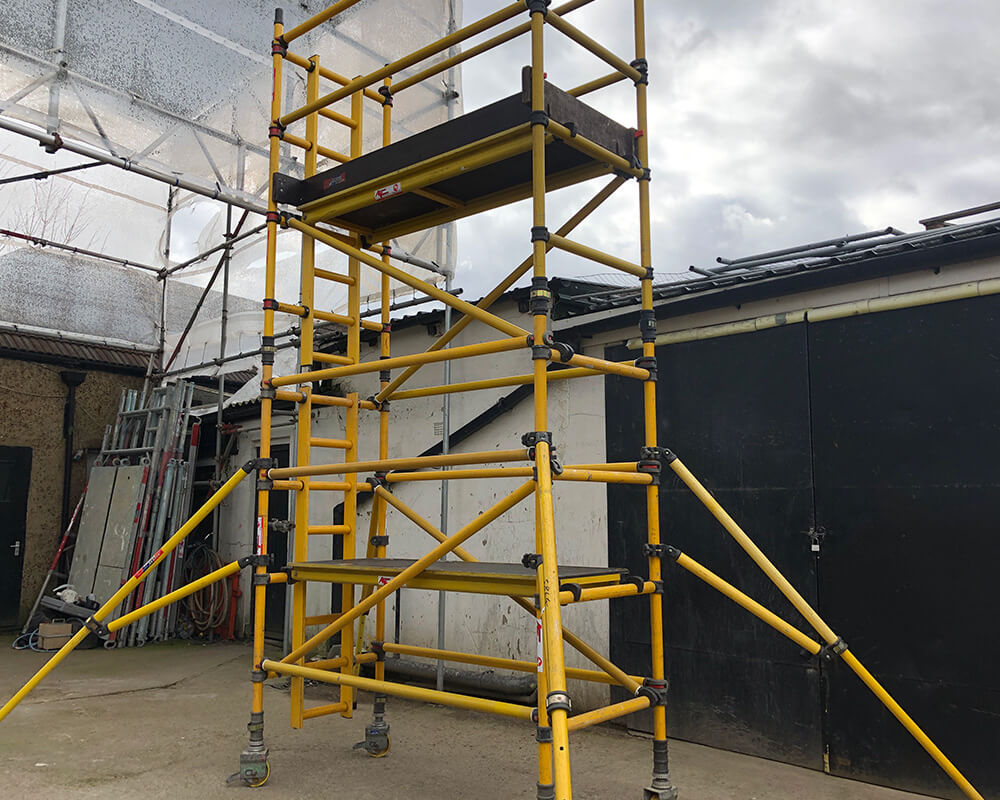
Can I still use access towers that comply to BS EN 1004:2004?
Yes, these towers are completely safe if they are in good working condition as these changes only apply to newly manufactured towers. * It is worth checking for updated instruction manuals for the tower you are using as it may change.
Product standard: BS EN 1139-6:2014
BS EN 1139-6:2014 is the other product standard for mobile access towers. This British standard covers mobile access towers outside of the realm of BS EN 1004:2020 but which use the same components and therefore need the same level of due diligence. *
BS EN 1139-6:2014 covers the following tower types:
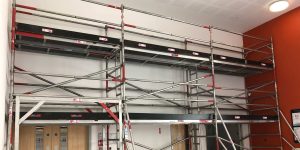
If you’re involved in a project involving working at height and you’d like to find out more about how Access Towers can help with our range of platforms to suit specialist jobs, get in touch today. For more information about any of our products or services call 0208 665 1181 to speak with a member of our friendly and professional team.
*Correct at time of publishing.
High level specialist decorating through intuitive design with Access Towers at The Wallace Collection
Gold leafing at the Wallace Collection Museum, London
Recently, a high-level specialist decorating company in London required the services of Access Towers to assist them in undertaking some specialist plasterwork at The Wallace Collection Museum in Manchester Square, London.
Decorating operatives were applying gold leafing decoration to the coving and architrave throughout several display rooms in the museum, which would provide additional elegance to the room, once filled with artefacts.
A job as delicate as this, working with the finest and most expensive materials to create intricate patterns can only be summarised as the definition of bespoke; such a job required the right tools for the job and that’s where Access Towers stepped in.
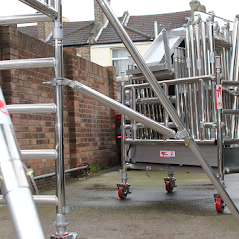
Planning, preparation and production with Access Towers
Before any work was carried out one of our specialist tower fitters was required to perform a site survey to access the proposed project. Using state-of-the-art technology, our fitter was able to measure the dimensions of each room with a high-quality laser measure, providing a degree of precision of up to 1mm, leaving no room for error on such a significant project. Through carrying out this survey our fitter identified a key problem with the task at hand, which was that as the decorators began to work their way down the wall there was restricted access due to the shape of the room. With this is mind our specialist installation team swooped in to resolve this problem by erecting our Cantilever Scaffold Tower, an ideal solution to this exact problem.
Spanning over the course of 4 weeks, the hired decorative operatives used our Narrow Width Cantilever Tower to offer access to the ceiling coving and when it came to applying the gold leafing lower down the wall, we built a cantilever platform out by 720mm which was counterweighted by a 200kg weight to balance the operatives on the cantilever platform; granting access to the restrictively positioned architrave.
Through this ingenuity, we were able to ensure the success of such a project that would only reflect the importance and integrity of British history. With the use of our Narrow Width Cantilever Tower the operatives could remain up close and personal, to carry out their elaborate work, without the worry of being on an unstable platform or the hassle of having to overstretch; potentially compromising the quality of the finished product.
Rental Access Tower’s throughout London
Our team of dedicated experts at Access Towers ensures the safety and correct installation of mobile access towers so that work in out of reach places can take place. With various options available such as low level towers consisting of Genie Lifts and Podium Units or for the high level, out of reach places we have Stair towers and Advanced Guardrail Scaffold Towers we’ll make sure you get the job done safely and properly. If you’re in the trade or perhaps require a one-off tower for a job, don’t hesitate to get in touch with us on 0208 665 1181 to speak to one of our knowledgeable friendly members of staff.