What is the current product standard for mobile access towers?
Product standard: BS EN 1004
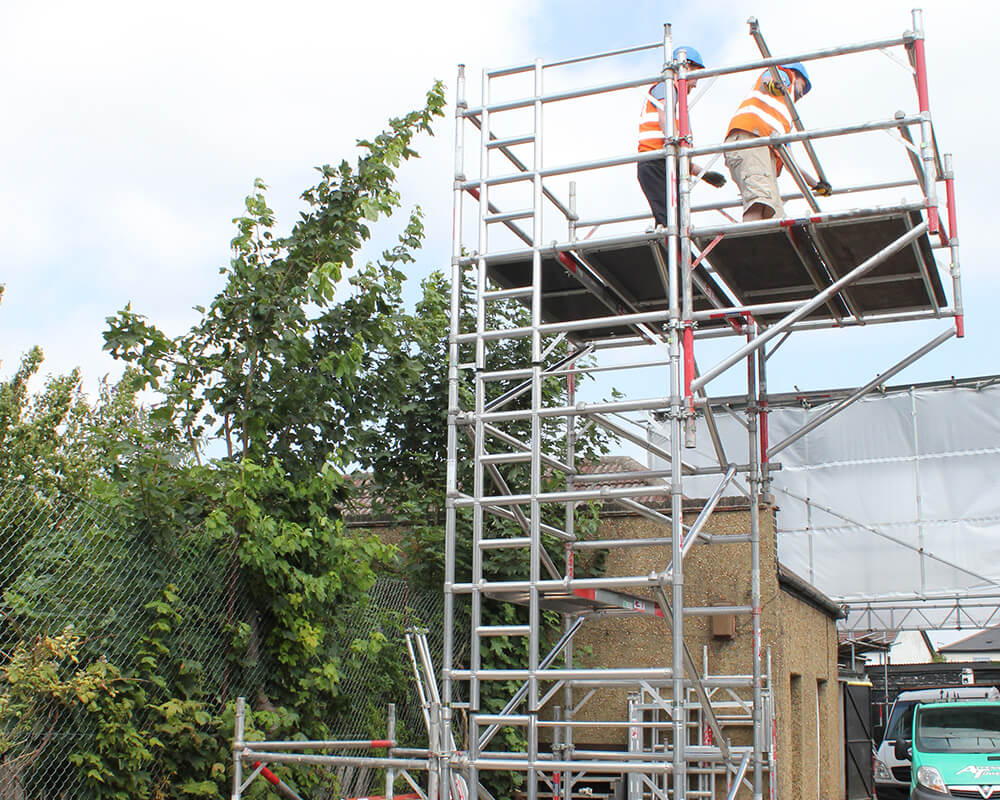
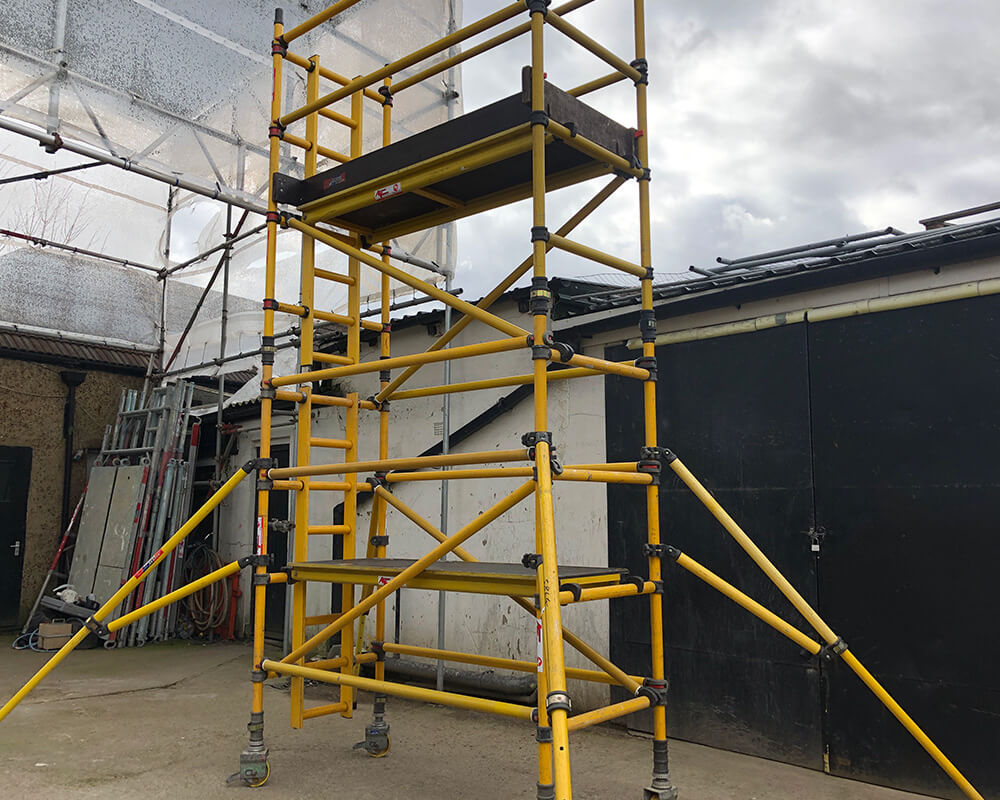
The product standard for mobile access towers is defined under the European standard: BS EN 1004:2004 which covers the manufacturing of mobile access scaffold towers of heights between 2.5m – 8m (external use) and 2.5m-12m (internal use). Any tower with BS EN 1004 certification ensures that the product conforms the minimum safety requirements and is fit for purpose and safe for all users during assembly, use and dismantle.
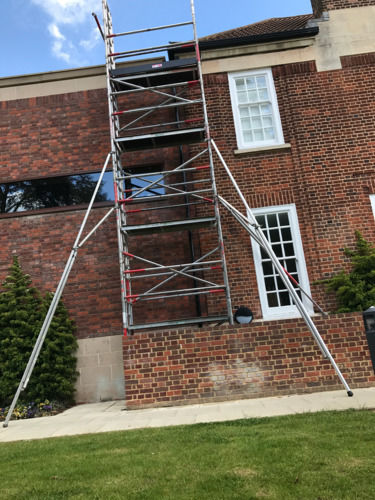
Its important access towers are regulated as they are pivotal in the work for many traders across London and the UK and need to be safe. For instance, recently a high level specialist decorating company required the use of a cantilever scaffold tower to gain access to an out of reach position on a job at the Wallace Collection Museum, London.
Key changes and transformation of BS EN 1004:2004 to BS EN 1004:2020
Towards the end of 2020, changes were put forth to BS EN 1004:2004 which were to be instated from 30th November 2021, thus changing the standard code from BS EN 1004:2004 to BS EN 1004:2020. In essence, any tower components manufactured past this point must conform to this new product standard to receive the certification. *
These key changes are brought in to make new mobile access towers even safer for all users and to reduce the risk of falling from heights. The changes are as follows:
Towers of all heights now fall under the scope of BS EN 1004 rather than towers 2.5m or higher.
Shorter distance between the first platform and the ground. This is now capped at 3.4m, reduced from 4.6m
Shorter distance between individual platforms. This is now capped at 2.25m, reduced from 4.2m.
Extra requirement that all platform decks are to be secured at both ends with double wind locks to ensure platforms don’t lift up in windy conditions.
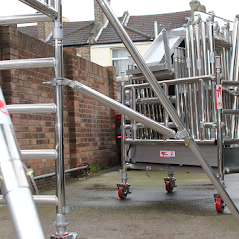
Extra measures in place to prevent castors from falling out.
Can I still use access towers that comply to BS EN 1004:2004?
Yes, these towers are completely safe if they are in good working condition as these changes only apply to newly manufactured towers. * It is worth checking for updated instruction manuals for the tower you are using as it may change.
Product standard: BS EN 1139-6:2014
BS EN 1139-6:2014 is the other product standard for mobile access towers. This British standard covers mobile access towers outside of the realm of BS EN 1004:2020 but which use the same components and therefore need the same level of due diligence. *
BS EN 1139-6:2014 covers the following tower types:
High Level towers greater than 12m (internal) and 8m (external)
If you’re involved in a project involving working at height and you’d like to find out more about how Access Towers can help with our range of platforms to suit specialist jobs, get in touch today. For more information about any of our products or services call 0208 665 1181 to speak with a member of our friendly and professional team.
*Correct at time of publishing.
High level specialist decorating through intuitive design with Access Towers at The Wallace Collection
Gold leafing at the Wallace Collection Museum, London
Recently, a high-level specialist decorating company in London required the services of Access Towers to assist them in undertaking some specialist plasterwork at The Wallace Collection Museum in Manchester Square, London.
Decorating operatives were applying gold leafing decoration to the coving and architrave throughout several display rooms in the museum, which would provide additional elegance to the room, once filled with artefacts.
A job as delicate as this, working with the finest and most expensive materials to create intricate patterns can only be summarised as the definition of bespoke; such a job required the right tools for the job and that’s where Access Towers stepped in.
Planning, preparation and production with Access Towers
Before any work was carried out one of our specialist tower fitters was required to perform a site survey to access the proposed project. Using state-of-the-art technology, our fitter was able to measure the dimensions of each room with a high-quality laser measure, providing a degree of precision of up to 1mm, leaving no room for error on such a significant project. Through carrying out this survey our fitter identified a key problem with the task at hand, which was that as the decorators began to work their way down the wall there was restricted access due to the shape of the room. With this is mind our specialist installation team swooped in to resolve this problem by erecting our Cantilever Scaffold Tower, an ideal solution to this exact problem.
Spanning over the course of 4 weeks, the hired decorative operatives used our Narrow Width Cantilever Tower to offer access to the ceiling coving and when it came to applying the gold leafing lower down the wall, we built a cantilever platform out by 720mm which was counterweighted by a 200kg weight to balance the operatives on the cantilever platform; granting access to the restrictively positioned architrave.
Through this ingenuity, we were able to ensure the success of such a project that would only reflect the importance and integrity of British history. With the use of our Narrow Width Cantilever Tower the operatives could remain up close and personal, to carry out their elaborate work, without the worry of being on an unstable platform or the hassle of having to overstretch; potentially compromising the quality of the finished product.
Rental Access Tower’s throughout London
Our team of dedicated experts at Access Towers ensures the safety and correct installation of mobile access towers so that work in out of reach places can take place. With various options available such as low level towers consisting of Genie Lifts and Podium Units or for the high level, out of reach places we have Stair towers and Advanced Guardrail Scaffold Towers we’ll make sure you get the job done safely and properly. If you’re in the trade or perhaps require a one-off tower for a job, don’t hesitate to get in touch with us on 0208 665 1181 to speak to one of our knowledgeable friendly members of staff.
8 reasons why construction companies prefer Access Towers PASMA Approved Training Courses
PASMA approved training courses are well-known throughout the construction industry. The courses provide training on the safe and correct way to use a variety of prefabricated mobile access towers. With a focus on health and safety, PASMA courses ensure that all attendees are competent when assembling, moving, using, and inspecting scaffold towers, podiums, and other access equipment.
Professional PASMA Approved Training Courses from Access Towers
At Access Towers, we run a range of PASMA courses from Monday to Sunday all year round. We can accommodate bespoke training requests and offer companies full training days either at our Croydon depot or onsite where required.
Our training courses usually focus on the safe and correct usage of low-level podium units and ladders while also providing training on the safe usage of towers on stairs and towers with cantilevers. If you regularly use any mechanical equipment such as cherry pickers and forklift trucks, we also provide a selection of IPAF courses.
Why choose PASMA training from Access Towers?
If you are based near Croydon, Sutton, or Mitcham, or even further afield in Southeast England, Access Towers PASMA training will enable you to safely work at heights and always adhere to industry regulations. When you choose Access Towers to provide your PASMA training you’ll enjoy the following benefits.
Full compliance with the 2005 working at height regulations
Flexible schedule with onsite and offsite courses available
PASMA certification awarded in just one day
PASMA training certificate is valid for 5 years
Competitive pricing from £120 – £150
Bespoke PASMA training for users and managers
Full COVID protection provided including gloves, masks, and sanitiser
Optional home theory completion (practical completed onsite)
PASMA approved training courses are a great way to ensure that your workers are competent when working with height access equipment. They also give your customers peace of mind that they are working with a reputable company.
To book a PASMA course, select a convenient date from our PASMA course calendar. For more information about Access Towers and any of our products and services call 0208 665 1181 or e-mail info@accesstowersgroup.co.uk
How do I get a replacement IPAF card? And more frequently asked questions
Also known as a PAL Card or IPAF Licence or certificate, short for International Powered Access Federation, IPAF Cards provide essential proof you have the correct training and experience to operate powered access equipment – such as Truck Mounts, Scissor Lifts and Cherry Pickers.
We’re often asked how to get an IPAF replacement card, so carry on reading to find out how along with a few more frequently asked questions on IPAF cards.
How do I get an IPAF replacement card?
If you’ve lost or mislaid your IPAF card, you’ll need to order a replacement from the IPAF-approved Training Centre where you completed your training. This information should be displayed on your IPAF certificate or in your logbook.
If you have already downloaded the IPAF ePAL app and added your IPAF licence, the contact details of your training centre will also be listed here.
If none of this information is available to you, you can call 01539 566700 or contact IPAF online to find out your operator number.
Please note, there is a fee for an IPAF replacement card. Alternatively, you can download the free ePAL and get a digital licence instead.
What is the free ePAL app?
Created to eliminate inconvenient paperwork, documents, and polluting plastic licences (that can easily get lost!), IPAF’s free ePAL app is a digital way to store and share your IPAF powered access licences and qualifications. It also has a handy logbook feature to easily record your time spent and operating experience, as well as the latest safety information and best practice guidance on operating powered access equipment at your fingertips.
How long does an IPAF card last?
IPAF and PASMA cards are both valid for 5 years from the date issued. After the expiry date, displayed on your card or app, you will need to take a refresher course or complete the full course again.
How long is an IPAF course?
Involving a mixture of theory and practical elements, depending on the training course, IPAF training courses generally take one to two days to complete.
Run by IPAF Approved training centres in London, Surrey & Kent, as IPAF members, IPAF training availability is between Monday-Saturday. Things are changing day by day, so if the course gets cancelled you will not be charged and a refund will be processed back to the same card within 1 working day.
The Work at Height Regulations 2005 were created by the Health and Safety Executive (HSE) and are designed to prevent death and injury caused by falls from height. The regulations are a legal framework designed to protect workers from serious physical injury and to give employers guidance on their legal duties in a working environment.
Who is responsible for ensuring compliance?
Employers have initial and overall responsibility to ensure that a working site is as safe as possible. They must ensure that any work at height is properly planned and supervised, and that the correct equipment and PPE (Personal Protective Equipment) is used correctly. Employers must carry out a risk assessment before any work begins and ensure that all workers undergo the necessary training to guarantee competence.
Employees also have legal responsibility when working at height. This is relevant to themselves, their employer, and other on-site workers. All employees must take reasonable care within the working area to ensure that their actions to not endanger themselves, other employers or any people present. They must undergo any health and safety training deemed necessary and cooperate with their employer with regards to on-site safety.
What is considered working at height?
Working at height is defined as ‘working in any environment where without precautionary measures in place, a fall from significant height could result in serious personal injury’. Examples of working at height include:
Working on a ladder
Working on a flat roof
Working on a raised platform
Working near an exposed opening in a floor or on the ground
Some environments which are commonly exposed to risk from working at height include:
Construction sites
Factories
Public sites (eg. Telecoms engineers, street lighting maintenance and installation, commercial painting)
Forestry areas
Although often overlooked, working from height includes any situation where a worker is required to use a raised platform or stepladder from where a fall could result in injury. This includes supermarket workers stacking shelves, warehouse operatives accessing goods and librarians sorting bookshelves.
What must you consider when planning work at height?
The HSE Working at Height Regulations exist for protection and to safeguard against accidents. As an employer, there are certain things that you must consider before undertaking any work from height. The law states that when planning and carrying out any work from height, you must consider the following factors.
Weather conditions which may compromise worker safety
Protection against falling objects or materials
Where necessary creating restricted access to people not directly involved in the project (eg. Cordons or exclusion zones to limit access to contractors or members of the public)
Ensuring all materials are safely stored
Thoroughly checking the working area for potential risks prior to work commencing
Planning for emergency situations in advance and ensuring all workers are conversant with emergency protocol
It is important to always view a working from height site in terms of minimizing risk. For example, only ever work from height where the elevation of workers is essential for the completion of the task.
Workplace assessment and using the right equipment for the job
As previously mentioned, all working at height situations must be carefully planned to minimize risk and optimise safety. Firstly, if it is possible to avoid working from height in the first place, you must consider using methods of working which are effective from ground level. This could include:
Using extendable tools
Installing low level alternative cables
Mechanically lowering electrical equipment for maintenance at ground level
Assembling products at ground level before installation
If working from height cannot be avoided, then you must plan to minimize risk to prevent a fall from occurring. Preventative measures include:
Using an existing ‘safe place’ to work from eg. A solid flat roof with existing perimeter wall
Installing guard rails where necessary
Using enclosed mobile lifting platforms
Installing tower scaffolds
Using worker restraints to prevent worker fall situations
In certain circumstances, it may be impossible to minimize the risk of a fall from height. If this is the case, then you must take appropriate action to limit the distance or consequence of a fall. These limitations may include:
Safety nets, air bags or other soft-landing systems installed close to the working at height level
Fall arrest systems with a high anchor point such as those used my mountaineers
Industrial rope access and restraints
PPE including helmets and other protective clothing
The use of ladders and scaffolding
There has often been confusion surrounding the use of ladders when working from height. Ladders are often considered dangerous with some people believing that their use has been banned. This is not true, however, and ladders are often the most suitable method of accessing raised areas depending on the site limitations.
In confined spaces for example, ladders or step ladders may be the safest option for gaining access to a raised area. When using ladders ensure that all workers are competent in their correct usage. If a scaffolding system is required, make sure that you work with a respected and professional company for your scaffolding supply.
At Access Towers, we supply fully regulated and rigorously tested scaffolding and access systems across Greater London and the South East of England. We can also provide our customers with on-site PASMA training to ensure that all employers and employees are conversant with the safe and proper usage of our access systems.
If you’re involved in a project involving working at height and you’d like to find out more about how Access Towers can help, get in touch today. For more information about any of our products or services call 0208 665 1181 today.
Benefits of Low-Level Access When Working At Height
When working at height on a construction site, having low-level access equipment can provide a safe and effective alternative to using ladders or scaffolding.
Ladders and scaffolding are staple pieces of equipment found on construction sites as a way to access heights at lower levels.
However, both those pieces of access equipment can cause falls, leading to workplace injuries, both fatal and non-fatal.
What Are The Benefits of Low-Level Access Lifts When Working At Height?
Low level access is often overlooked, and not selected as the ‘equipment of choice’ on a construction site. But, low level access is a practical solution for working at low heights.
1. Productivity
Using low level access equipment can also boost productivity and efficiency on site due to its ease of manoeuvrability.
2. Easy manoeuvrability
One benefit to having low level access is the ability to easily manoeuvre it around the place in which you’re working without having to dismantle it.
The disadvantage to scaffold towers is that if you want to move it, you first have to dismantle, then move it, and then reassemble. This is considerably more time consuming than using a piece of low level access equipment which can be easily moved around.
3. Cost
The last benefit we’re going to mention is the cost. It may not be the cheapest option, but when you factor in other elements, such as the cost of assembling, moving and dismantling at both the start and end of the hire.
Low level access is extremely flexible in terms of working at height. The operator is able to lift to the exact height they need without any hassle.
Contact Access Towers
If you’re looking for low-level access equipment for your project, look no further than Access Towers Services. We hire out our equipment on a weekly basis for competitive prices, with the best part being you can extend the hire period for as long as you need.
To talk to us about low-level access needs, give us a call on 0208 665 1181 or send us an email and we’ll get back to you as soon as we can.
Frequently Asked Questions: Working At Height
What are the risks of working at height?
Working at height comes with a lot of risks; the main being falling and causing fatal or non-fatal injuries. If someone falls from working at height, it is estimated that on average they will be off work for around 9.4 days.
In previous years, between 30 – 40 injuries to workers have been fatal due to falling from a height. For more information and statistics from HSE on working at height, please check out their ‘Fatal Injuries Report’.
What height is considered ‘working at height’?
You may be wondering, ‘what is classed as working at height’? Well, working at height is defined as working in a place where, if there were no precautions in place, then a person could fall a distance liable to cause personal injury or death. Under this definition, there are no specific height or measurement classifications.
Typically, insurance companies will usually cover work at 0 – 3 metres, with some policies covering between 3 – 5 metres. Those policies covering higher height ranges are typically bespoke. There is a misconception around working from height, and this is assumed to be due to different insurance policies. The misconception is that only working above 3 metres is considered working from height, however, this is not true.
For full details on working from height, you can take awareness and informational courses that cover everything you need to know. Here at Access Towers Services Ltd, we specialise in providing PASMA Courses and cover everything you need to know when working with access equipment and at height.
How long is working at height valid?
Working at height training certificates don’t technically have legal or mandatory expiry dates. However, some industry sectors require or recommend refresher training courses. The recommended time between refreshed courses and re-training is every 3 to 5 years.
Before any work at height is carried out, all sectors and organisations insist upon safety awareness training.
What are the working at height regulations?
The Work At Height Regulations 2005 is the main piece of legislation relating to working from height. This regulation applies to all operations carried out at height, regardless of: the work equipment being used; the duration of the work; and lastly, the height at which the work is performed.
These regulations put a crucial importance and emphasis on employers to apply a 3-stage hierarchy for working at height.
Avoid working at height – Do as much as possible from ground level
Prevent a fall from occurring
Minimise the distance and/ or consequence of a fall from occurring
In addition to the above legislation, there is also The Health and Safety At Work Act 1974 (HSWA). This act places legal duty on employers, and employees, to make sure they comply with all their health and safety duties and requirements. This includes taking reasonable care of workers and others who may be affected by your actions.
HSWA sets out general duties that outline what responsibilities employers have towards employees and members of the public. Furthermore, it covers duties that employees have to themselves and to each other; as well as covering certain self-employed people and the duties they have towards themselves and others.
Both these legislations and acts place legal responsibility onto employers to carry out risk assessments on any working at height activities. It also helps ensure that training is supplied to employees engaged in working at height activities to ensure the risk of falling are minimised.
What types of tradespeople work at height?
All tradespeople, such as plumbers or electricians, will encounter jobs and activities where they will be required to work at height. This is mainly because the definition of ‘working at height’ encompasses working at any place where there is a risk of falling from a distance liable to cause personal injury. This applies both inside of buildings as well as outside, and even underground. For example, even a librarian placing books onto a shelf and using a stool is classed as working from height.
What are the “do’s” and “don’ts” of working at height?
When it comes to the “do’s” and “don’ts” of working at height, it is important to consider The Work At Height Regulations 2005 Act, with particular reference and focus on the 3-Stage hierarchy.
The first piece of advice is to avoid working from height where possible, but if it cannot be avoided then a risk assessment must be carried out. Risk assessments are a legal duty and it must take into account the following things: the ability of the worker; the nature and duration of the work; other influences such as weather conditions and fragile surfaces; the required level of supervision; required PPE (personal protective equipment); the presence of fall arrest systems (such as soft landing systems and netting); and lastly, the need for emergency and rescue procedures.
The most important things to do when working at height include ensuring you adequately plan the activity. By law, you should take into account the weather conditions; check the place is safe to work before every use; take measures to prevent injury and stop objects from falling; storing materials and objects safely so that they will not cause injury; and lastly, to plan for emergencies and rescue or agree on a set procedure for evacuation.
The main “don’t” is to not take unnecessary risks. Always opt for a sensible and pragmatic approach.
What is the maximum wind speed for working at height?
The short answer is: there isn’t one. There isn’t a maximum wind speed for working at height. However, wind speed should be taken into consideration as a factor during the risk assessment. High speed winds can make a task much higher risk. Therefore, this will be a crucial element in determining if the weather conditions are too risky to work safely at height.
When is a working at height permit required?
Working at height permits is a requirement that is very much dependent on the construction site or contractor that you are working for or with. A permit to work at height is a safe system of work that ensures all hazardous work on a site is controlled.
Contact Access Towers
If you’re interested in PASMA training so that you or your employees can safely work at height, please contact our team here at Access Towers Services Ltd. Our expert course leaders offer courses at our site here in Croydon. You can book a course online, or find out more information by giving us a call today on 0208 665 1181 or filling out our online contact form.
Working At Height: 5 Alternatives to Scaffolding
When working at height, and being able to access great heights for extended periods, scaffolding is the most common solution. Why? Because scaffolding is reliable, stable and a safe way to reach higher levels.
However, there are alternatives you can use when working at height. What are they, and why might you be seeking a scaffolding alternative?
The first reason is that erecting scaffolding takes time. It also needs to be carried out by a properly trained and certified scaffolding company. Sometimes this might not be the best, or most convenient option for you. Also, depending on the project, there may not be enough space to set up scaffolding. Here are some alternatives to scaffolding that can work well in the right situations.
What can I use instead of scaffolding?
Access towers
An access tower is similar in its appearance to scaffolding, and it also gives you the same capabilities as scaffolding. The difference is that no installation is required. Sometimes they’re not quite as big as traditional scaffolding, nor can they be custom-built, but access towers are perfect for a wide variety of uses and scenarios.
Although access towers cannot be custom-made, they do come in different sizes. This means that it gives you a large working surface, while also supporting you firmly and helping prevent falls.
It is imperative that anyone working at height knows the correct protocol and has the appropriate training and equipment for the situation, that’s why Access Towers Services Ltd offers comprehensive PASMA training.
Scissor lifts
Whenever you need them, scissor lifts are easy to move into the position you need them for due to their wheeled base units. This is the perfect solution for projects where you might need to move the platform regularly.
Some benefits of scissor lifts are easily adjustable, and they’re safe, solid and stable – the only three “S’s” you need to remember.
Ladder
A simple choice, perhaps an obvious one too. But, this option is so often forgotten, even though many of us have and own ladders at home. If you need a taller, adjustable ladder than the one you currently have, they are available to hire to give you that extra height you need.
Access platform
This alternative to scaffolding is similar to access towers in the sense that the platform is rectangular, meaning that you can use the flat long surface to carry out your work. An access platform is particularly great for rooftop work. It can be extended along the side of a building, providing easy access to all aspects of the roof. For large areas, an access platform is a safer more convenient option as opposed to a tower or ladder, as it provides stability.
Cherry pickers / boom lifts
Depending on the level of height you want or need to reach, this is a great alternative. Whatever term you use, cherry picker, boom lift or powered access booms, these pieces of machinery can be used indoors or outdoors. They allow you to reach difficult spots that are hard to reach with ease and give you powered manoeuvrability.
Contact Access Towers Services Limited
Interested in getting your PASMA certificate? It has never been easier with Access Towers Services Ltd. Our expert course leaders offer courses at our site here in Croydon. You can book a course online, or find out more information by giving us a call today on 0208 665 1181 or filling out our online contact form.
Do I Need PASMA Training?
What is PASMA training?
Prefabricated Access Suppliers and Manufacturers’ Association, often shortened to the acronym ‘PASMA’, is a well-known training association that focuses on using mobile access towers safely and promotes best practice. Everyone at PASMA is an industry expert, meaning that they are an ideal association to provide essential training and skills for people working at every level within the height industry. There are a number of PASMA approved training centres across the country that thousands of people attend every year.
Do I need PASMA training?
If you’re working with tower scaffolds then PASMA training and certification is recommended as it ensures best practice is followed. Working at height regulations apply to all those working in the industry where there is a possibility of a fall that could cause personal injury. The regulations ensure that everyone working at height is competent to do so.
As an employer, it is your duty to ensure employees are properly trained and competent, not only does this help reduce the risk of accidents or incidents occurring, but it helps make their role easier when they’re aware of best practices and safety procedures.
So who should attend a PASMA training course? The standard training course is aimed at anyone involved in the use of mobile access towers. By attending training and passing the course, it enables people to safely erect, use, inspect and dismantle mobile access towers.
What’s the difference between IPAF and PASMA training?
To meet the latest working at height regulations and to protect the safety of staff that work at height, PASMA and IPAF are necessary training courses to undertake. However, both cover different aspects of working at height. So determining the most suitable course for you or your employees will depend on the method of access on the worksite. Ask yourself: are you using powered access or mobile access towers?
International Powered Access Federation, commonly known as ‘IPAF’, is a course that covers the safe use of powered access. PASMA, on the other hand, focuses on the safe use of mobile access towers. Both these types of equipment are different, therefore they require slightly different and tailored training.
Erecting Mobile Access Towers? Get PASMA trained
A PASMA training course focuses on safely using mobile access towers, also known as mobile scaffold towers. As their name suggests, mobile towers are non-powered and can be maneuvered using wheels at their base.
It is a working at height regulation that requires the assembly of a mobile access tower to be carried out by, or under the supervision of, appropriately trained personnel. For those that want to erect their own towers, it must be carried out by fully trained staff. Furthermore, if you have staff using the equipment but not assembling, then those staff should also undertake a PASMA training course to ensure that they’re safe when working.
Using Powered Access? Choose IPAF training
A IPAF training course focuses on ensuring the safe and efficient use of powered access equipment or mobile elevating work platforms, known as ‘MEWPS’. It is a course predominantly designed for operators, users, demonstrators and instructors.
What does powered access equipment include? Powered access encompasses equipment such as cherry pickers, scissor lifts and boom lifts. Essentially, it is any equipment that is powered by electricity or diesel. For heights that are unreachable by mobile access towers, using powered access equipment is ideal; this is because boom lifts and cherry pickers offer stable and safe access to heights both horizontally and vertically.
Which is best?
Whilst other courses such as IPAF can be undertaken instead of PASMA, sometimes alternative courses are overlooked when working with a mobile tower, and you will be asked to show a PASMA card first.
IPAF and PASMA training courses are different and do cover working with different working at height equipment. Selecting the right course for you should ultimately come down to which equipment you use. If you or your staff work with both types of access equipment, then attending both types of training is advised.
Both of these training courses offer a 5-year certification and equip your staff to be able to meet health and safe regulations for working at height.
Contact Access Towers Services
Interested in getting your PASMA certificate? It has never been easier with Access Towers Services Ltd. Our expert course leaders offer courses at our site here in Croydon. You can book a course online, or find out more information by giving us a call today on 0208 665 1181 or filling out our online contact form.
How PASMA Training Can Benefit You
PASMA training courses can benefit both employers and employees in a number of ways. Attaining PASMA certification gives invaluable, practical knowledge that allows users to be safer when working from height. Access Tower Services Ltd breaks down some of the key benefits in the following article.
Boost Your CV
Having a PASMA certificate can give you a competitive edge over other employees. Whether you’re just starting out or you’ve been in the field for a few years, evidence of PASMA approved training is an attractive trait. Many employers will have to pay to send their new employees on these courses, so the fact you already have one saves them a cost. More importantly, it shows that you’re serious about your profession and that’s something money can’t buy.
Further Safety
We all know the potential risks for working at height. As well as ensuring you (and, if applicable, your workers) are equipped with the correct equipment is vital, but so is knowledge. During your PASMA certified course, you’ll receive comprehensive safety training that is essential for lowering the risks of working at height. The training will both increase your own safety as well as the safety of your colleagues because you may notice practices that could be made safer.
Peace of Mind
When you receive training from a PASMA certified course, you know that the experience you are getting is of high quality. The Prefabricated Access Suppliers’ and Manufacturers’ Association is a renowned not-for-profit organisation that is dedicated to increasing the safety of all mobile access tower workers. If a course is PASMA approved, you know that you’re getting something worthwhile.
Access Towers Are Proud To Offer PASMA Training
Getting a PASMA certificate has never been easier with Access Towers Services. Our expert course leaders offer a variety of courses either on our site here in Croydon or across other areas of the South East, including Sutton and Mitcham. You can book a course online our find out more information either here on our site or by giving us a call on 0208 665 1181.
We use cookies
Some are needed to make the site work, and our live chat sets its own cookies so it is ready the moment you need it. Others help us see how the site is used so we can improve it — those are yours to choose. Read our Cookie Policy.